Top 5 Tech Trends Dominating Nigeria in 2026 (And Why They Matter)

Introduction To Technology
Technology is transforming West Africa at an unprecedented pace. From artificial intelligence tools helping local businesses automate operations to advanced digital payment platforms streamlining daily commerce, innovation is reshaping how citizens live, work, learn, and earn. In 2026, the country’s expanding digital economy highlights the primary **tech trends dominating nigeria** as new opportunities open up for local entrepreneurs, students, and corporate institutions alike.
With internet penetration increasing and smartphone adoption reaching new heights, Lagos and Abuja have secured global recognition as leading technology hubs. Local startups continue to attract major venture capital investment while modern digital skills become highly prized. In this analytical review, we explore the top 5 **tech trends dominating nigeria** in 2026 and evaluate why they matter directly to individuals, businesses, and macroeconomic progress.
Table of Contents: Digital Trends Analysis
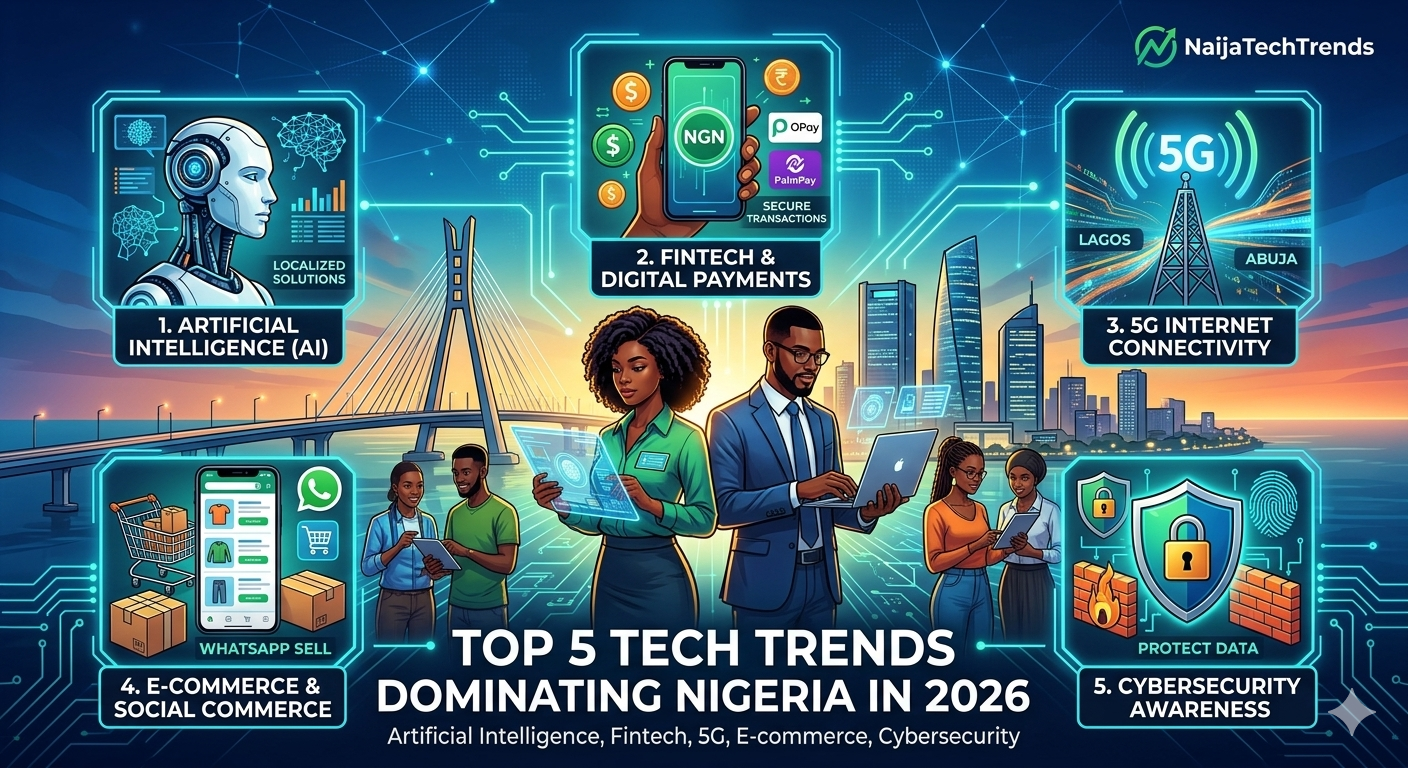
- 1. Artificial Intelligence (AI) Becomes Mainstream
- 2. Fintech and Digital Payments Continue to Expand
- 3. 5G Internet and Faster Connectivity
- 4. Growth of E-Commerce and Social Commerce
- 5. Cybersecurity Awareness and Digital Safety
- How These Tech Trends Are Shaping Nigeria’s Future
1. Artificial Intelligence (AI) Becomes Mainstream
According to global insights from the World Economic Forum, artificial intelligence is no longer an abstract or futuristic concept. In 2026, integrated AI infrastructure has solidified its place as one of the most visible **tech trends dominating nigeria**. Many progressive corporations now rely on machine learning tools to automate repetitive tasks, improve customer engagement matrices, analyze complex data sets, and scale productivity.
- Customer Support Chatbots: Handling real-time user queries smoothly for local online retailers and commercial agencies.
- Content Creation Tools: Assisting local copywriters, digital creators, and brand marketers with creative optimization.
- Business Automation Systems: Streamlining supply chains and inventory monitoring setups for growing consumer businesses.
- AI-Powered Education: Offering customized study paths and digital research models for tertiary students nationwide.

By saving processing hours and minimizing operational costs, machine learning tools empower freelancers to offer highly technical services across global markets. This digital transition ensures that AI remains central among the major **tech trends dominating nigeria** for the foreseeable future. However, balancing this expansion requires mindful digital literacy campaigns to mitigate concerns regarding data privacy and online misinformation.
2. Fintech and Digital Payments Continue to Expand
The local marketplace remains one of Africa’s most active digital finance ecosystems, cementing mobile banking as a foundational layer among the **tech trends dominating nigeria**. Mobile payment applications managed by financial innovators like OPay, PalmPay, and Moniepoint have completely replaced traditional cash reliance for millions of citizens, making cashless utility transfers an everyday standard.
| Traditional Banking Era | Modern 2026 Fintech Era |
|---|---|
| Long physical bank queues & manual paper forms | Instant mobile application transfers & wallet systems |
| High monthly maintenance charges on debit cards | Low-fee digital accounts & automated cashbacks |
| Slow financial integration inside rural spaces | Massive nationwide POS agency banking networks |
Key drivers behind this fintech momentum in 2026 include improved transfer settlement velocities, lower transaction drop rates, automated peer-to-peer savings tools, and biometric security protections. Furthermore, the rapid adoption of instant QR code checkouts enables traditional marketplace merchants to accept immediate digital payments effortlessly, driving financial inclusion deep into rural ecosystems.
3. 5G Internet and Faster Connectivity
The aggressive commercial rollout of fifth-generation networks across dense metropolitan areas is transforming local access speeds. High-speed telecommunications infrastructure has officially emerged as one of the critical structural **tech trends dominating nigeria**, offering low latency thresholds alongside reliable download pipelines.
Compared to aging legacy arrays, 5G delivers the data capacity needed to run modern cloud operations and complex corporate networks without interruptions. Virtual learning institutions leverage this speed to stream high-definition instructional modules, while remote medical units use stable links to manage digital patient records and virtual health consultations seamlessly across state lines.
4. Growth of E-Commerce and Social Commerce
Online retail platforms have seen an extraordinary surge in user engagement as consumers shift away from physical markets. Buyers now show a clear preference for sourcing household items and electronics via dedicated online portals or trusted social media storefronts. For context on parallel entertainment media trends, readers can view our detailed review of the upcoming Asake new album tracklist updates detailing creative industries.

This commerce acceleration is powered by affordable data subscriptions, massive mobile smartphone usage, and secure checkout gateways like Paystack and Flutterwave. Because entrepreneurs can establish functional web storefronts without paying for physical properties, social commerce on WhatsApp and Instagram has grown into one of the largest entrepreneurial **tech trends dominating nigeria**, expanding the local logistics, supply chain, and delivery sectors.
5. Cybersecurity Awareness and Digital Safety
With more daily transactions moving online, protecting digital assets has become an urgent corporate and individual priority. The widespread shift toward online services has led to a rise in sophisticated cyberthreats, including phishing schemes, fake investment portals, and ransomware tactics. As a result, implementing strict enterprise digital defense networks stands as one of the most critical security-focused **tech trends dominating nigeria** in 2026.
To stay safe, users must adopt proactive data security measures, such as enforcing multi-factor authentication (2FA) across personal accounts, avoiding unverified web links promising government grants, and utilizing randomized password managers. This rising threat landscape has created a strong demand for skilled local professionals to fill high-paying corporate security roles, including vulnerability analysts, information defense consultants, and cloud security engineers.
How These Tech Trends Are Shaping Nigeria’s Future
The core digital transformations happening today are closely connected and building upon one another. Advanced artificial intelligence requires the fast bandwidth of 5G networks, fintech platforms require modern cybersecurity frameworks to protect user trust, and e-commerce networks rely heavily on secure digital payment options. Together, these unified **tech trends dominating nigeria** are laying the groundwork for an efficient, interconnected economy.
While challenges like power grid consistency and rural data coverage still require attention, the momentum of the digital sector in 2026 shows that transformation is moving forward rapidly. For students and business owners alike, keeping pace with these changes is essential. Developing strong digital skills remains the most effective way to succeed as the local technology landscape continues to evolve.